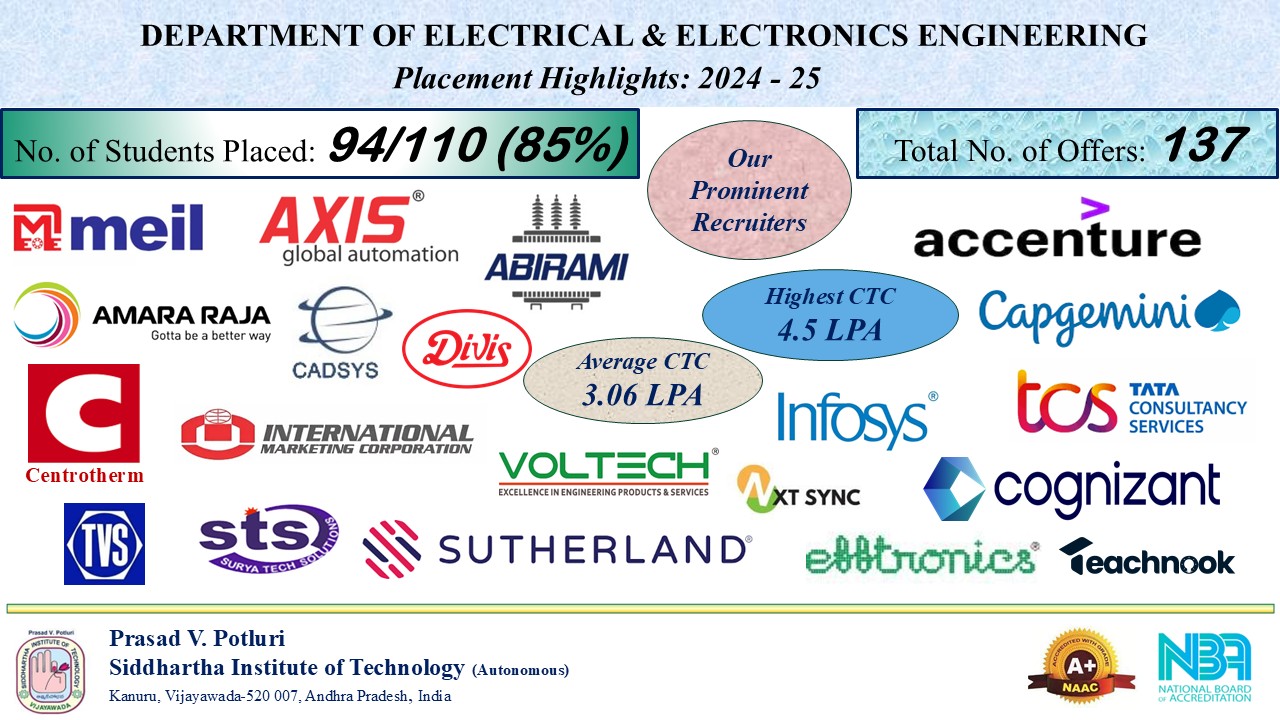
Placements – Academic Year 2024–25 (Number of Students Placed: 94, Number of Offers: 137)
Placements – Academic Year 2023–24 (Number of Students Placed: 102, Number of Offers: 137)

Unnat Bharat Abhiyan Grant
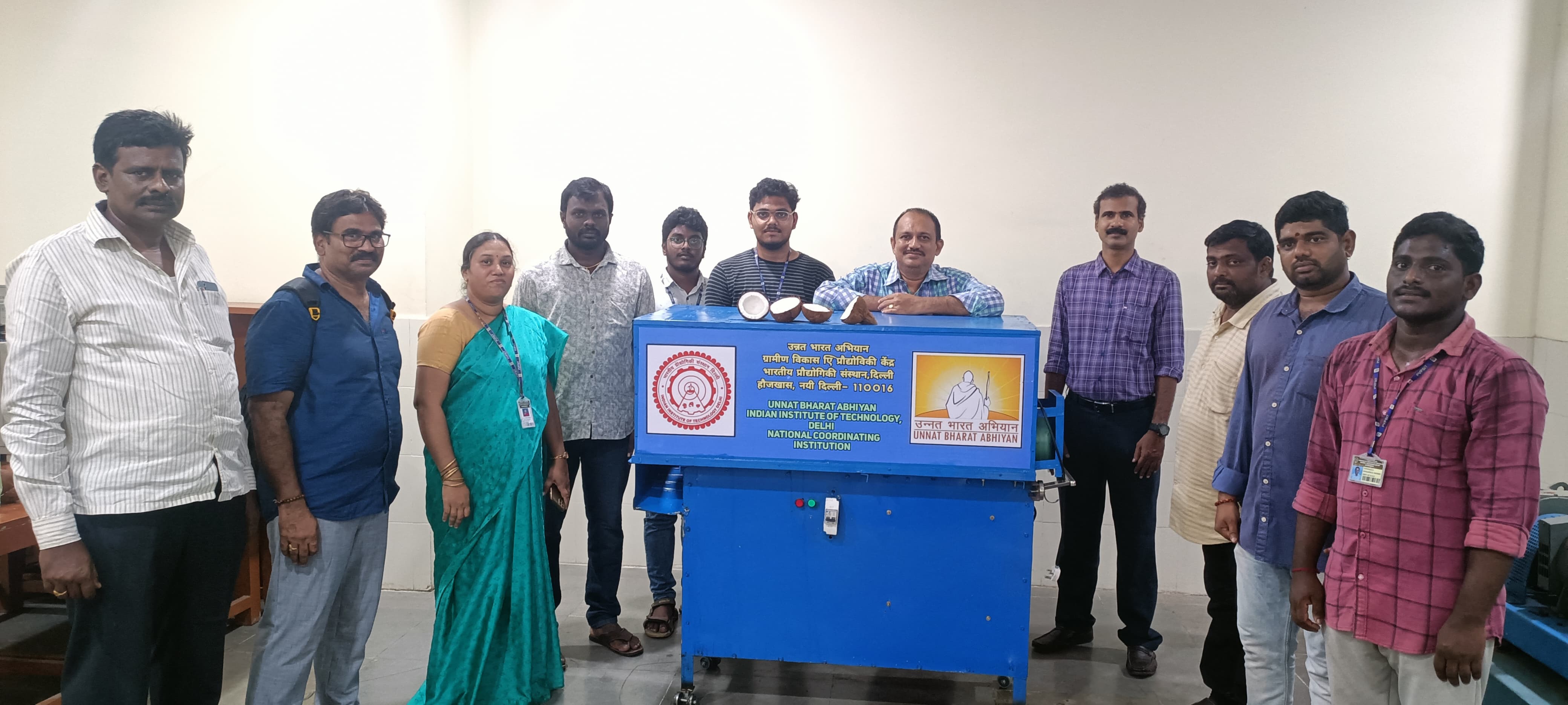
Dr. D. Ragaleela (PI) and Dr. Ch. Padmanabha Raju received ₹91,000 for the project “Development of an Automated Coconut Breaking Machine” (18 January 2024).

MSME Idea Hackathon 3.0
Dr. D. Ragaleela’s proposal “Tender Coconut Punching Machine” approved with funding of ₹15,00,000 (29 February 2024).


Placements – Academic Year 2022–23 (Number of Students Placed: 95, Number of Offers: 143)
Placements – Academic Year 2021–22 (Number of Students Placed: 80, Number of Offers: 140)

Facilities

Our Assets

Power Systems Lab

This lab allows students to analyze power system components and perform experiments on transmission lines, load flow studies, fault analysis, and protection systems. It aids in understanding generation, transmission, and distribution through simulation and hardware setups.

Power Electronics Lab

Students explore the operation and characteristics of power semiconductor devices and converters such as rectifiers, inverters, choppers, and AC voltage controllers. The lab focuses on practical applications in drives and renewable energy systems.

Control Systems Lab

This lab focuses on analysing fundamental concepts of control systems. Students study time and frequency responses, stability analysis, and PID controllers using both hardware and simulation tools like MATLAB and Programmable Logic Controllers (PLC).

Network Lab

The Network Lab introduces students to basic and advanced electrical circuit analysis techniques. It includes experiments on Thevenin’s, Norton’s, and superposition theorems, resonance, and transient response using RLC circuits.

DC Machines Lab

This lab involves the study and testing of DC motors and generators. Students learn about speed control, load testing, and efficiency measurement of different DC machines.

AC Machines Lab

Students perform experiments on single-phase and three-phase AC motors and generators, including synchronous and induction machines. Emphasis is placed on performance, control, and characteristics.

Electrical Measurements Lab

This lab develops skills in measuring electrical quantities such as voltage, current, power, energy, and resistance using analog and digital instruments, bridges, and transducers.

Microprocessor and Microcontrollers Lab

The lab offers hands-on experience in programming and interfacing 8086 microprocessors and 8051 microcontrollers. Students design simple embedded systems for control and automation applications.

Electrical Simulation Lab

This lab uses software tools like MATLAB, PSIM, PSPICE and PSCAD to simulate Electrical circuits, power systems, Power Electronics, and control systems. It enhances analytical skills without relying solely on hardware.

Internet of Things (IoT) Lab

The Internet of Things (IoT) Lab equips students with hands-on experience in building smart systems using microcontrollers such as Arduino and Raspberry Pi. Students learn to interface and program a range of components, including LEDs, buzzers, digital and analog sensors (IR, LDR, temperature, humidity), OLED displays, Bluetooth, WiFi modules, and cloud platforms like ThingSpeak.

Basic Electrical & Electronics Engineering Lab

This foundational lab covers basic circuit theory, wiring, soldering, and simple electronic components. It prepares first-year students to understand the principles of electrical and electronics engineering.

Basic Electronic Devices and Circuits Lab

The lab introduces diodes, transistors, and basic amplifiers. Students perform experiments on rectifiers, filters, and oscillators to understand analog circuit design.

Electrical Workshop

Students gain hands-on skills in electrical wiring, motor winding, house wiring, and safety practices. It provides practical exposure to real-world electrical installations.

Projects Lab

A dedicated space where students design, develop, and test their final-year projects using hardware and software tools. It promotes innovation, teamwork, and application of interdisciplinary knowledge.